
Imagine building a house without blueprints, without knowing the soil quality, or without understanding where the water pipes and electrical lines run. Sounds risky, right? Yet, for many years, dental implant surgery often relied on limited 2D information – much like building a house with only a front elevation drawing. But what if you could have a detailed, 3D “GPS map” of your entire jaw? A map that showed every bone, nerve, and sinus cavity, allowing your dentist to plan your implant placement with microscopic precision before any surgery even begins?
This isn’t science fiction; it’s the reality of Cone Beam Computed Tomography (CBCT) and guided dental implant surgery, a game-changer for both safety and stunning results.
Why Your Smile Deserves a 3D Blueprint: The CBCT Advantage
For decades, traditional dental X-rays offered a flat, two-dimensional view of your mouth.
While essential for many procedures, they couldn’t reveal the full, complex anatomy of your jawbone in 3D.
When it comes to something as intricate as placing a dental implant, which needs to integrate perfectly with your bone and avoid vital structures, a flat image leaves too much to chance.
This is where CBCT technology steps in, transforming uncertainty into absolute clarity.
Seeing Beyond the Surface with CBCT
A Cone Beam Computed Tomography (CBCT) scan is a specialized type of X-ray that creates incredibly detailed, three-dimensional images of your teeth, soft tissues, nerve pathways, and bone in a single scan.
Think of it as a super-advanced, dental-specific CT scan that uses a cone-shaped X-ray beam, resulting in less radiation exposure compared to medical CT scans, while providing superior detail for dental applications.
Why is this 3D view so vital for dental implants?
- Bone Quality & Quantity: Implants need healthy, sufficient bone to integrate properly. CBCT allows your dentist to accurately measure bone height and width, and even assess its density. This helps determine if you have enough bone for an implant or if a bone graft might be needed. This is a critical factor, as insufficient bone is a leading cause of implant failure without proper planning.
- Anatomical Hazards: Your jaw is a bustling neighborhood of vital structures. CBCT pinpoints the exact location of nerves (like the inferior alveolar nerve, which runs through your lower jaw), blood vessels, and sinus cavities with astonishing accuracy. This prevents accidental damage, a major concern that significantly impacts patient safety and comfort.
- Optimal Placement: The success of a dental implant isn’t just about placing it; it’s about placing it in the best possible position to support your future crown, bridge, or denture. This is known as a “prosthetically driven” approach. CBCT helps determine the ideal angulation and depth for the implant to achieve both functional stability and beautiful aesthetics.
Understanding these foundational concepts is your first step towards making informed decisions about your dental health.
The Digital Dance: From 3D Scan to Guided Surgery
Once your CBCT scan is complete, the real magic of digital dentistry begins. The high-resolution 3D data from your scan is transferred to specialized planning software.
This initiates a meticulous digital workflow, transforming raw data into a precise surgical blueprint.
Step-by-Step: The Guided Implant Journey
1. The Virtual Operating Room: Detailed Planning
Your dentist, acting as a digital architect, uses the CBCT data to create a virtual 3D model of your jaw. Within this digital model, they can:
- Map out your anatomy: Every nerve, sinus, and bone contour is clearly visible.
- Virtually place implants: Your dentist can experiment with different implant sizes, types, and positions, testing various scenarios to find the absolute best fit for your unique anatomy and restorative needs. This ensures the implant will support your future tooth perfectly.
- Assess bone density: The software can provide quantitative data on bone density, allowing the selection of the most appropriate implant type and surgical technique to ensure long-term stability.
This virtual planning phase addresses several knowledge gaps often present in traditional methods.
For instance, it provides precise measurements (e.g., bone density units) that directly translate into clinical decisions about implant type and drilling protocols, significantly reducing guesswork.
2. The Power of Merging Data: Intraoral Scans Meet CBCT
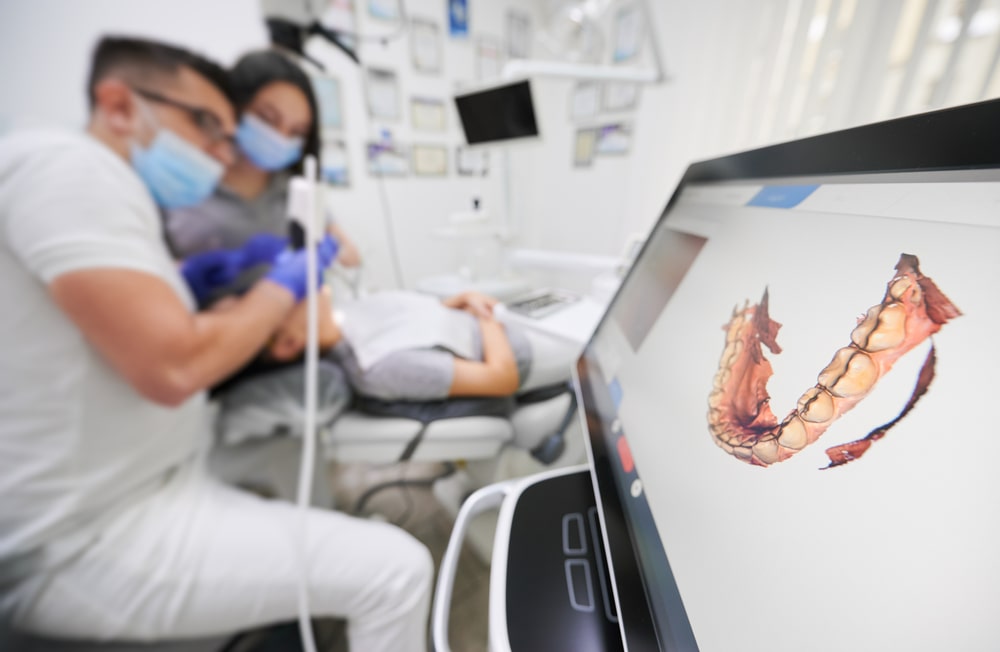
Often, the CBCT data is merged with a digital impression of your teeth taken with an intraoral scanner.
This creates a complete 3D picture, showing both the internal bone structure and the external tooth and gum contours.
This synergy is crucial for a truly prosthetically-driven plan, ensuring the implant isn’t just well-seated in bone, but also perfectly aligned with your existing bite and aesthetic goals.
(Even in cases with heavily restored teeth where intraoral scanning might be challenging, advanced software and techniques allow for accurate guide creation, demonstrating the versatility of the digital workflow.)
3. Crafting the “GPS for Surgery”: The Surgical Guide
Once the virtual plan is finalized, a custom surgical guide is designed. This guide is a clear, biocompatible template, usually fabricated using advanced 3D printing technology, unique to your mouth.
It fits precisely over your existing teeth or gum ridges.
The guide has small, precisely placed openings that direct the surgical drills to the exact predetermined depth, angle, and position.
It’s essentially a physical manifestation of your dentist’s digital blueprint.
4. The Surgery Day: Precision in Action
During the actual implant surgery, the custom guide is seated securely in your mouth.
Your dentist uses it to guide the drills and place the implant with unparalleled accuracy.
Benefits of using a surgical guide during the procedure:
- Enhanced Safety: By precisely controlling the drill’s path, the risk of damaging nerves, sinuses, or adjacent teeth is dramatically reduced. This is a primary driver for utilizing guided surgery and significantly boosts patient confidence.
- Increased Accuracy: Studies show that guided implant surgery can achieve greater accuracy (often within 0.5-1mm of the planned position) compared to freehand methods. This precision is vital for the long-term success and stability of the implant.
- Reduced Surgical Time: With a pre-planned and guided approach, the surgery itself can be quicker, leading to less chair time for you.
- Potentially Less Discomfort & Faster Recovery: Because the surgery is so precise, it can often be less invasive, potentially leading to less post-operative swelling and discomfort, and a quicker return to your normal routine.
This entire process epitomizes the ethical dentistry and patient-centered care that we champion at Radiance Artistic Dental & Wellness.
We believe in transparency and empowering you with the knowledge to make the best decisions for your health.
Beyond the Basics: Addressing Your Concerns & Advanced Insights
While the benefits of CBCT-guided surgery are profound, it’s natural to have questions. Let’s tackle some common concerns and delve into nuances often overlooked.
Common Questions & Myth Busting
Q: Is CBCT radiation dangerous?
A: This is a common concern. CBCT scans use significantly less radiation than a traditional medical CT scan – often up to 10 times less! Modern dental CBCT machines are designed to focus the beam precisely, limiting exposure to a specific area. Your dentist will only recommend a CBCT when the diagnostic benefits far outweigh the minimal risks, following strict safety protocols. It’s important to weigh the small radiation dose against the significant benefits of preventing complications like nerve damage.
Q: Do I always need a CBCT scan for a dental implant?
A: While highly recommended for its precision and safety benefits, particularly for complex cases or multiple implants, a CBCT scan isn’t always absolutely mandatory for every single implant. However, given its ability to prevent complications and optimize outcomes, many leading practitioners consider it the gold standard for implant planning. When you consider the long-term investment in an implant, the diagnostic value of a CBCT is immense.
Q: How accurate are these digital surgical guides?
A: Very accurate! Research consistently shows that guided implant surgery achieves high levels of precision, typically placing implants within a millimeter or less of the planned position. This level of accuracy is extremely difficult, if not impossible, to achieve with traditional freehand techniques, especially in areas with complex anatomy.
Q: What about the cost of a CBCT scan?
A: The cost of a CBCT scan is an investment in the safety and success of your implant. While it adds to the overall cost of the procedure, it significantly reduces the risk of costly complications (like nerve damage or implant failure) that could arise from less precise planning. Many dental insurance plans offer some coverage for CBCT scans when deemed medically necessary for implant planning. We believe in transparent pricing and will always discuss all costs upfront.
Q: Can CBCT help if I have limited bone?
A: Absolutely. CBCT is invaluable for assessing cases with limited bone. It allows the dentist to precisely map the existing bone, determine if bone grafting is necessary, and plan the graft procedure with greater predictability. It can also help identify the best implant size and design to maximize integration with available bone.
The Holistic View: Beyond the Implant
The precision offered by CBCT-guided surgery aligns perfectly with a holistic approach to your overall wellness.
By ensuring the longevity and health of your dental implants, we contribute to your ability to chew, speak, and smile confidently, which are all integral parts of your quality of life.
A well-planned and stable implant reduces the risk of future dental issues and supports your complete oral health ecosystem.
We incorporate advanced technologies and preventative treatments as part of our commitment to your long-term health, not just quick fixes.
Your Journey to a Confident Smile Starts Here
The evolution of dental technology, particularly with CBCT and guided surgery, has revolutionized dental implantology, making it safer, more predictable, and more precise than ever before. For those considering dental implants, understanding this advanced planning process offers peace of mind and confidence in achieving the best possible outcome. Ready to explore how a meticulously planned dental implant can restore your smile and confidence? The first step is an in-depth consultation. We invite you to learn more about [What to Expect During Your First Dental Implant Consultation] and how we can create a personalized plan just for you.
Connect with Radiance Artistic Dental & Wellness in Boulder, Colorado, where ethical dentistry meets cutting-edge technology to create smiles that last a lifetime.


